-
tel:
+86 13357917888 -
email:
sales@cxrollformer.com


Flying Saw Cutting Machine
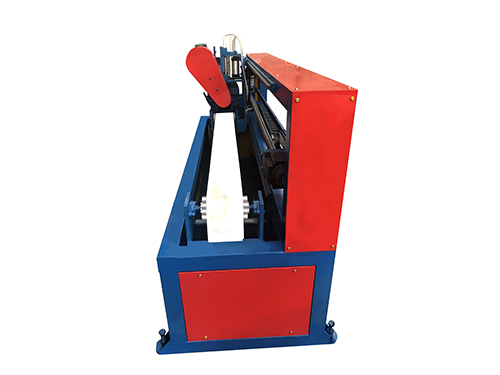
A flying saw cuts roll formed or welded sections to length while the material keeps moving, so the line never has to stop for a cut. Chuangxu builds flying saws in Changzhou, China as standalone units or integrated into new forming and tube lines.
What this machine does
A flying saw travels with the moving section while its blade cuts through, then returns to the start position. Because the material never stops, output is continuous and cut length does not limit line speed the way a stop-and-cut station does. That is the difference between a line that runs at its forming speed and one that runs at its cutting speed.
Machine configuration
| Function | Cut-to-length on the fly for roll formed and welded sections |
|---|---|
| Cutting method | Carbide saw blade for tube and closed sections; alternative blades for open profiles |
| Travel | Servo driven carriage synchronised to line speed |
| Length control | Encoder based measurement with length and batch count set on the panel |
| Accuracy | Length tolerance agreed at specification for the section and speed |
| Integration | Supplied standalone, or integrated into a new forming or tube line |
| Power supply | Three-phase, voltage and frequency matched to destination country |
| Safety | Guarded blade, interlocked enclosure and emergency stop |
Typical applications
- Tube mills — cutting welded tube continuously at line speed
- Roll forming lines — cutting purlins, profiles and panels without stopping
- Existing line upgrades — replacing a stop-and-cut station to raise output
- High volume production — where cut length otherwise limits line speed
How to specify your line
- State the section and wall thickness. Blade type, saw power and clamping all follow from what is being cut.
- State the maximum line speed. The carriage has to accelerate to that speed, and a saw sized for slower lines will become the limit.
- Agree the length tolerance. Tolerance and speed trade against each other, so both are fixed together.
- Check the interface with the existing line. Signal handshake, run-out table and discharge all need to match, which is why retrofits start with a line survey.
Delivery and service
- Minimum order — 1 set.
- Payment — L/C or T/T.
- Incoterms — CFR, FOB, CIF, EXW.
- Shipping — ocean freight from Shanghai port.
- Overseas support — service outlets and showrooms in Canada, Egypt, Turkey, the United Kingdom, the United States, Italy, France, Brazil, Peru and Saudi Arabia; out-of-warranty support online.
Frequently asked questions
How much does a flying saw cost?
Price depends on section size, wall thickness, maximum line speed, blade type and whether it is integrated into a line. Send the section and speed specification for a quotation.
Can it be added to a line we already run?
Yes, retrofits are common; the line survey establishes the speed, the interface signals and the run-out arrangement.
What length tolerance should we expect?
Tolerance is agreed at specification and depends on line speed and section; it is not a fixed number for every application.
What is the minimum order quantity?
One set.
What is the lead time?
Confirmed once section, thickness and speed are fixed.
What terms apply?
L/C or T/T, CFR, FOB, CIF or EXW, ocean freight from Shanghai, out-of-warranty support online.
Related Products




Contact US
Product Information
Quantity
Unit
Piece
Support order samples, customization, wholesale direct, and complete payment. If the product you look for does not have corresponding customized content, pls fill out the form below to contact us, and we will reply ASAP.