-
tel:
+86 13357917888 -
email:
sales@cxrollformer.com


Metal Anti-wind Rolling Shutter Door Equipment
An anti-wind rolling shutter door line forms reinforced slats with a deeper interlock and heavier gauge, so the curtain resists wind pressure instead of bowing out of its guides. Chuangxu builds these lines in Changzhou, China for shutter manufacturers supplying exposed and coastal sites.
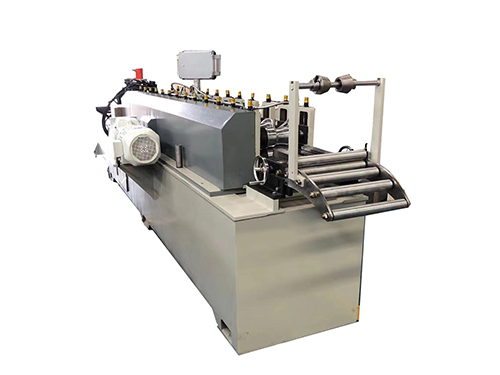


What this machine does
An anti-wind shutter line forms slats that differ from standard curtain in two ways: deeper interlock and heavier gauge. Those two changes are what stop a wide curtain from lifting out of its guides under wind load. The forming line is otherwise the same family as a standard shutter line, which is why the specification conversation is usually about slat section rather than machine type.
Machine configuration
| Function | Cold forming of reinforced roller shutter slats with inline cutting |
|---|---|
| Raw material | Galvanized steel strip, prepainted strip, aluminium strip |
| Slat section | Deep interlock and reinforced profile formed to your wind load requirement |
| Gauge range | Heavier than standard curtain, agreed at specification |
| Cutting | Servo flying cut or hydraulic stop cut |
| Control system | PLC with touch screen for length and quantity |
| Power supply | Three-phase, voltage and frequency matched to destination country |
| Roll design | Designed in-house with German COPRA roll forming software |
Typical applications
- Exposed shopfronts — openings that face prevailing wind
- Coastal and elevated sites — higher wind pressure than inland streets
- Industrial doorways — wide openings where a standard slat bows
- Shutter manufacturers — a second slat range alongside standard curtain
How to specify your line
- Start from the wind load and opening size. The required slat section follows from wind pressure and clear width, not from the machine.
- Check the guide system. A reinforced slat needs matching guides and a heavier axle box, so the whole door is specified together.
- Confirm the gauge. Heavier strip raises forming force and changes the roll set, so it cannot be treated as a variation of a standard line.
- Decide the finish. Prepainted slats need film protection on a line that already handles heavier strip.
Delivery and service
- Minimum order — 1 set, built to drawing.
- Payment — L/C or T/T.
- Incoterms — CFR, FOB, CIF, EXW.
- Shipping — ocean freight from Shanghai port.
- Overseas support — service outlets and showrooms in Canada, Egypt, Turkey, the United Kingdom, the United States, Italy, France, Brazil, Peru and Saudi Arabia; out-of-warranty support online.
Frequently asked questions
How much does an anti-wind shutter line cost?
Price depends on slat section, strip gauge, station count and cutting method. Send the slat drawing and the wind load your door must meet for a configured quotation.
What makes it anti-wind compared with a standard line?
Deeper interlock and heavier gauge, which together keep a wide curtain in its guides; the forming principle is the same.
Can the same line also run standard slat?
With a second roll set, yes; the two slat sections need different rolls.
What is the minimum order quantity?
One set, built to your slat drawing.
What is the lead time?
Confirmed once slat section, gauge and cutting method are fixed.
What terms apply?
L/C or T/T, CFR, FOB, CIF or EXW, ocean freight from Shanghai, out-of-warranty support online.
Related Products










Contact US
Product Information
Quantity
Unit
Piece
Support order samples, customization, wholesale direct, and complete payment. If the product you look for does not have corresponding customized content, pls fill out the form below to contact us, and we will reply ASAP.