-
tel:
+86 13357917888 -
email:
sales@cxrollformer.com

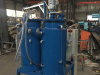
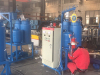
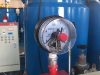
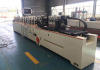
Foam Rolling Shutter Door Low Pressure Foam Machine
A low pressure foaming machine injects polyurethane into roller shutter slats and door panels to fill the cavity with insulation, metering and mixing two components at a controlled ratio. Chuangxu builds these units in Changzhou, China to work alongside slat and panel forming lines.
What this machine does
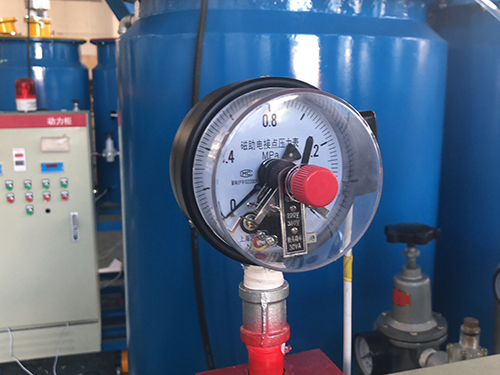
A low pressure foaming machine meters two chemical components, mixes them and injects the mixture into a cavity such as a shutter slat or a door panel. The foam then expands to fill the section and sets into the insulation layer. Low pressure means the mixing head works at moderate pressure, so the equipment is simpler and cheaper to maintain than a high pressure unit, at the cost of a slower cycle.
Machine configuration
| Function | Two component polyurethane metering, mixing and injection for insulated sections |
|---|---|
| Mixing | Low pressure mixing head with adjustable shot size and ratio |
| Metering | Independent pumps for isocyanate and polyol, ratio set on the control panel |
| Tanks | Insulated day tanks with agitation and temperature control |
| Heating | Component heating to keep viscosity stable through the working day |
| Cycle | Shot sequence matched to the line speed or the manual filling station |
| Power supply | Three-phase, voltage and frequency matched to destination country |
| Integration | Supplied to work with a new slat or panel line, or as a standalone filling station |
Typical applications
- Insulated shutter slats — foam filled profiles for thermal doors
- Garage and industrial door panels — cavity filling between panel skins
- Cold store doors — insulated sections for low temperature openings
- Existing lines — adding insulation to a line that currently forms hollow sections
How to specify your line
- Start from the cavity, not the machine. Slat or panel volume per metre decides shot size, and shot size decides the mixing head.
- State the output rhythm. Continuous inline foaming and manual station filling need different cycle rates.
- Agree the chemistry. Formulation, cream time and density come from your chemical supplier, and the machine is configured around them.
- Plan temperature control. Component temperature drift is the most common cause of inconsistent foam, so heating and day tanks are part of the specification.
Delivery and service
- Minimum order — 1 set.
- Payment — L/C or T/T.
- Incoterms — CFR, FOB, CIF, EXW.
- Shipping — ocean freight from Shanghai port.
- Overseas support — service outlets and showrooms in Canada, Egypt, Turkey, the United Kingdom, the United States, Italy, France, Brazil, Peru and Saudi Arabia; out-of-warranty support online.
Frequently asked questions
How much does a low pressure foaming machine cost?
Price depends on shot size, output rhythm, tank and heating configuration, and whether it is integrated into a line. Send the section drawing and required output for a quotation.
Low pressure or high pressure?
Low pressure suits moderate output and simpler maintenance; high pressure is chosen when output or foam quality demands a faster, finer mix.
Can it be added to a line we already run?
Yes, as a standalone filling station or integrated unit, provided the slat geometry and line speed are known.
What is the minimum order quantity?
One set.
What is the lead time?
Confirmed once cavity volume, output rhythm and chemical system are fixed.
What terms apply?
L/C or T/T, CFR, FOB, CIF or EXW, ocean freight from Shanghai, out-of-warranty support online.
Related Products




Contact US
Product Information
Quantity
Unit
Piece
Support order samples, customization, wholesale direct, and complete payment. If the product you look for does not have corresponding customized content, pls fill out the form below to contact us, and we will reply ASAP.