-
tel:
+86 13357917888 -
email:
sales@cxrollformer.com


Cable Tray Equipment
A cable tray roll forming machine produces perforated and ladder type tray sections from steel strip, with inline punching and cut-to-length. Chuangxu builds these lines in Changzhou, China for tray manufacturers, electrical contractors and enclosure fabricators.
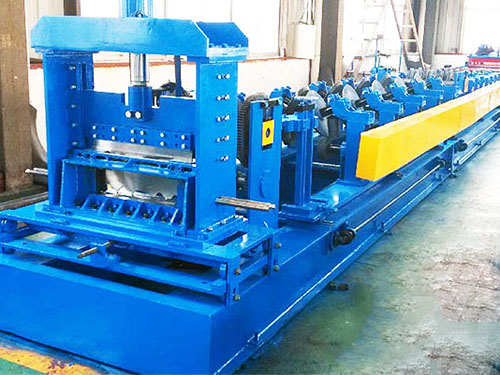
What this machine does
A cable tray line forms the side rail and return of a tray from steel strip, punches the cable fixing holes and cuts each section to length without a second operation. Output is a tray component ready for finishing, which is why the line suits manufacturers supplying electrical installation projects rather than a single building site.
Machine configuration
| Function | Cold forming of cable tray sections with inline punching and cut-to-length |
|---|---|
| Raw material | Galvanized steel strip, cold rolled strip; prepainted strip for coated tray |
| Tray types | Perforated tray, ladder type tray and trough sections, formed to your profile drawing |
| Punching | Hydraulic punching unit for base and side perforation; die set matched to your hole pattern |
| Cutting | Servo flying cut or hydraulic stop cut |
| Control system | PLC with touch screen for length, quantity and batch count |
| Power supply | Three-phase, voltage and frequency matched to destination country |
| Finishing | Hot dip galvanizing or powder coating handled downstream, outside the forming line |
| Roll design | Designed in-house with German COPRA roll forming software |
Typical applications
- Electrical installation projects — tray runs for power and data cabling in commercial buildings
- Tray manufacturers — serial production of standard widths for stock
- Panel and enclosure fabricators — tray matched to switchgear and control cabinet layouts
- Industrial plants — cable routing for retrofit and expansion works
How to specify your line
- Decide tray type first. Perforated, ladder and trough sections need different roll sets and different punching dies, so the profile drawing comes before anything else.
- Fix the width range. A line built for one width is cheaper; a line with adjustable width costs more but covers more of the catalogue.
- Agree the perforation pattern. Hole size, pitch and open area determine the punching tonnage and the die design.
- Plan the finishing step. If the tray is hot dip galvanized after forming, allow for handling and drainage in the layout rather than assuming the line covers it.
Delivery and service
- Minimum order — 1 set, built to drawing.
- Payment — L/C or T/T.
- Incoterms — CFR, FOB, CIF, EXW.
- Shipping — ocean freight from Shanghai port.
- Overseas support — service outlets and showrooms in Canada, Egypt, Turkey, the United Kingdom, the United States, Italy, France, Brazil, Peru and Saudi Arabia; out-of-warranty support online.
Frequently asked questions
How much does a cable tray roll forming machine cost?
Cost depends on tray width range, strip thickness, whether width is adjustable, the punching die set and the cutting method. Send the profile and perforation drawing for a configured quotation.
Can the line produce several tray widths?
Yes. Width can be fixed for a single size or made adjustable, and the choice is made at specification stage because it changes the frame and the roll design.
Does the line include galvanizing?
No. Hot dip galvanizing and powder coating are separate processes; the forming line delivers the formed, punched and cut component.
What is the minimum order quantity?
One set. Lines are configured to the buyer's tray profile rather than sold from stock.
What is the lead time?
Lead time is confirmed after the profile drawing, width range and punching pattern are agreed, since station count follows from them.
What terms do you ship on?
L/C or T/T, with CFR, FOB, CIF or EXW, shipped by sea from Shanghai, and out-of-warranty support handled online.
Related Products




Contact US
Product Information
Quantity
Unit
Piece
Support order samples, customization, wholesale direct, and complete payment. If the product you look for does not have corresponding customized content, pls fill out the form below to contact us, and we will reply ASAP.