-
tel:
+86 13357917888 -
email:
sales@cxrollformer.com

Insulation Panel Line: What to Specify Before You Buy
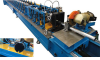
Short answer: specify the panel range (thickness, width, length), the skins you will run, how foam density and thickness are controlled, the cutting method, the edge joint, and which optional stations you need. Output on a sandwich panel line is limited by foam cure and cutting cycle, not by the former.
What the line has to deliver
A polyurethane sandwich panel line produces insulated panels continuously: upper and lower skins are fed, a foamed PU core is injected between them, the panel is consolidated, edge-trimmed and cut to length. The decorative face is part of the product, so an insulation panel line is usually specified together with a decorative roll former or an embossing station upstream.
That combination is why buyers get this specification wrong. They size the line for panels, then discover the decorative face, the joint detail or the film lamination was never in the scope.
Six specifications that decide the line
1. Panel range
State the full range you intend to sell: minimum and maximum thickness, working width, and maximum length. A line built around a single thickness works well until the second product arrives.
2. Skins
Prepainted steel coil, galvanized coil, and stainless coil for food grade panels are the usual inputs. Stainless is not steel with a different paint — it forms differently and it is harder on the rolls. Say which skins you will actually run.
3. Foaming: density and thickness control
The foaming station runs continuously, with foam density and panel thickness controlled on the line. This is where most output claims are made and most panel rejects come from. Ask how density is measured and corrected during a run, not only how it is set at start-up.
4. Cutting
Flying cut for panel length, with edge trimming in line. Cutting is often the real bottleneck: a line that forms quickly but cuts slowly delivers fewer panels per shift than its former rating suggests.
5. Control system
A line PLC with touch screen, coordinated across forming, foaming and cutting. Coordination is the point — if the three stages are controlled separately, thickness and length drift independently.
6. Optional stations
Embossing, film lamination, and groove-and-tongue edge profiling are normally optional. Decide at specification stage: retrofitting an embossing station onto a running line is a rebuild, not an upgrade.
Configuration to compare against
| Item | Typical specification |
|---|---|
| Function | Continuous production of polyurethane insulated sandwich panels |
| Raw material | Prepainted steel coil, galvanized coil, stainless coil for food grade panels |
| Panel construction | Upper and lower skin with foamed PU core and formed edge joint |
| Foaming | Continuous PU foaming station with density and thickness controlled on the line |
| Cutting | Flying cut for panel length; edge trimming in line |
| Control system | Line PLC with touch screen, coordinated across forming, foaming and cutting |
| Optional stations | Embossing, film lamination, groove and tongue edge profiling |
| Roll design | Designed in-house with COPRA roll forming software |
| Power supply | Three-phase, voltage and frequency matched to destination country |
Full configuration: polyurethane sandwich panel equipment.
What actually limits output
Three things, in order:
- Foam cure. The panel cannot be cut before the core has taken load. Belt length and line speed have to be matched to the chemistry you use, not to the former's maximum speed.
- Cutting cycle. A flying cut that cannot keep pace sets the ceiling for the whole line.
- Changeover. Thickness and width changes cost time. If your product mix is wide and your order sizes are small, changeover will decide your real capacity.
Ask every supplier for output as panels per shift for your product mix, and ask what the figure assumes about cure time and changeover. A number quoted without those assumptions is a marketing number.
The decorative face is a separate specification
Insulation panels are sold on appearance as much as on thermal performance. If the visible face is embossed or profiled, that station has its own requirements — pattern depth, roll specification, coating handling — and it is specified like any other embossing line rather than as an accessory.
For the decorative side, see the exterior decorative roll panel machine and the metal embossing machine. Both are specified by pattern depth and tooling, for the reasons set out in how to check embossed panel quality.
Environmental claims, stated carefully
Insulation panels are often presented as an environmental product because the panel is durable, can be dismantled and reused, and reduces wall thickness compared with traditional masonry. Those are properties of the finished panel and the construction method, not of the machine.
What can be verified at purchase is narrower and more useful: the panel's fire classification from the core material, the dimensional stability of the panel over time, and whether the line can hold thickness tolerance in production. Ask for those, in writing, rather than for a general environmental claim.
Frequently asked questions
Can one line produce several panel thicknesses?
Yes, within the mechanical range of the line, but each thickness change costs changeover time. Specify the range and the order sizes together — a wide range with small batches has a different real capacity than the same range with long runs.
Is embossing always included?
No. Embossing, film lamination and groove-and-tongue edge profiling are normally optional stations. If the panel is sold on its appearance, the embossing station belongs in the original scope.
Why does roll design matter on a sandwich line?
The skin profiles and the edge joint are formed by rolls designed for that joint geometry. Roll design is done in-house with COPRA roll forming software so the joint and the panel edge are designed together rather than assembled from standard profiles.
What is the minimum order and the commercial terms?
One set, configured to the panel range. Payment by L/C or T/T. Incoterms CFR, FOB, CIF or EXW. Ocean freight from Shanghai port.
Next step
Send the panel range (thickness, width, length), the skins you will run, your order sizes, and whether the visible face needs embossing or film. That is enough to configure a line instead of estimating one. Contact us or review the panel line range.
Related News

Contact US
Product Information
Quantity
Unit
Piece
Support order samples, customization, wholesale direct, and complete payment. If the product you look for does not have corresponding customized content, pls fill out the form below to contact us, and we will reply ASAP.