-
tel:
+86 13357917888 -
email:
sales@cxrollformer.com

Metal Carving Panel Machine: How to Specify Before Buying
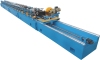
Short answer: a metal carving panel machine is specified by five things — pattern depth and how the pattern is transferred, panel width, substrate and coating, output per shift at that depth, and tooling scope. Tooling is the real purchase decision, because on a carving line the pattern is the product.
What a carving panel line actually does
A metal carving panel line presses a relief pattern into coated steel or aluminium sheet so a flat panel reads as a carved surface. The pattern is transferred in one of two ways: by patterned forming rolls for continuous repeat patterns, or by a press station when the relief has to be deeper. The sheet is then cut to panel length.
That single sentence contains the fork in the road. Rolls and a press station are not two grades of the same machine — they produce different products, and the choice follows from the pattern you intend to sell.
Which specification decides the machine first?
Pattern depth decides the transfer method, and the transfer method decides everything else.
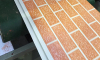
- Continuous, shallow-to-medium repeat patterns — woodgrain, stone, brick, stucco textures — run on patterned rolls. The pattern repeats as the strip passes, output is continuous, and the roll is the tool.
- Deeper relief that has to hold its shape — carved panel effects where the surface has to read as physically cut — needs a press station, because a roll cannot push that depth into coated sheet without damaging the coating or the roll.
If a quotation does not state which method it is pricing, the quote is not comparable to anything.
The five specifications to fix before you ask for a price
1. Pattern depth and pattern coverage
Depth is the number that drives tonnage, roll design and line speed. State the depth range you need, not just the pattern name. If you are buying a pattern from a designer, get the depth in millimetres before approaching machine suppliers.
2. Panel width and coil width
Panel width sets the roll face width and the coil width you must be able to buy. Decide the widest panel in your catalogue, not the average one — a line built for the average will not run your flagship product.
3. Substrate and coating
Prepainted steel sheet, aluminium sheet and coated aluminium behave differently under the same roll. Coating type and thickness decide whether the surface survives the forming pass. Tell the supplier the exact substrate and coating you will run, and ask what they assume if you do not.
4. Output per shift, not nominal line speed
Nominal speed is measured on a good day with a cooperative coil. What you actually buy is panels per shift at your pattern depth, including changeover, coil changes and rejected panels. Ask for output at your depth, and accept a realistic number rather than a flattering one.
5. Tooling scope
On a carving line the tooling is most of the value. Confirm in writing:
- how many patterns are included in the price
- what artwork input is needed — a vector file, or a physical sample for tooling development
- whether a second pattern needs a second roll or a second die
- what a replacement roll costs and how long it takes
Machine configuration to compare against
| Item | Typical specification |
|---|---|
| Function | Pattern forming and cut-to-size for decorative metal panels |
| Raw material | Prepainted steel sheet, aluminium sheet, coated aluminium |
| Pattern transfer | Patterned forming rolls for continuous patterns, or press station for deeper relief |
| Pattern tooling | Engraved rolls made to your artwork; tooling is the main specification item |
| Cutting | Cut-to-size for panel length |
| Surface handling | Protective film on the visible face, soft handling throughout |
| Power supply | Three-phase, voltage and frequency matched to destination country |
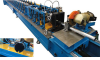
Full configuration: metal carving decoration panel forming equipment. For deeper relief produced by a press rather than rolls, see the track press machine.
How to compare two quotations fairly
Two quotes for "a carving panel line" can differ by a factor of two and both be honest. Before comparing price, put both on the same footing:
- Same pattern depth and same number of patterns included?
- Same substrate gauge and coating assumption?
- Cut-to-size included, or is cutting a separate machine?
- Protective film application and soft-handling rolls included?
- Commissioning, operator training and spare rolls included?
A quote that is cheaper because it excludes tooling is not a cheaper machine. It is a quote for less machine.
Mistakes that cost money after delivery
Buying on nominal line speed. The number that matters is panels per shift at your depth. A line that runs fast on shallow patterns and stalls on deep ones will not deliver the order book you planned.
Forgetting panel handling. Large decorated panels are damaged in handling more often than in pressing. Budget for racks, suction lifters or two-person handling before the line arrives, not after the first claim.
Assuming one roll runs every pattern. On a roll machine the pattern is fixed in the engraved roll. A new pattern usually means a new roll.
Not budgeting the second pattern at the start. Most buyers add a pattern within the first year. Pricing the second roll at the same time as the line is almost always cheaper than buying it later on its own.
Frequently asked questions
Can one machine run more than one pattern?
On an engraved-roll machine the pattern is fixed in the roll, so a second pattern needs its own roll. On a press-station machine a second pattern needs its own die. Either way, plan the second pattern as a purchase, not as a setting.
Rolls or a press station — which should I choose?
Choose rolls for continuous repeat textures at shallow to medium depth, where output matters. Choose a press station when the relief has to be deep enough that a roll would distort the coating or the panel.
What do you need from me to quote the tooling?
The pattern as artwork, or a physical sample panel for tooling development, plus the depth range, panel width and the substrate you intend to run.
What is the minimum order?
One set, with tooling made to your pattern.
What are the commercial terms?
Payment by L/C or T/T. Incoterms CFR, FOB, CIF or EXW. Ocean freight from Shanghai port.
Next step
Send the pattern (artwork or sample), the depth range, the widest panel you intend to sell and the substrate you will run. With those four items a line can be specified properly instead of approximately. Contact us or review the metal embossing machine range.
Related News

Contact US
Product Information
Quantity
Unit
Piece
Support order samples, customization, wholesale direct, and complete payment. If the product you look for does not have corresponding customized content, pls fill out the form below to contact us, and we will reply ASAP.