-
tel:
+86 13357917888 -
email:
sales@cxrollformer.com


Polyurethane Sandwich Panel Equipment
A polyurethane sandwich panel line forms both steel skins, foams the PU core between them and cuts insulated panels to length in one continuous process. Chuangxu builds these lines in Changzhou, China for cold store builders and prefabricated construction suppliers.
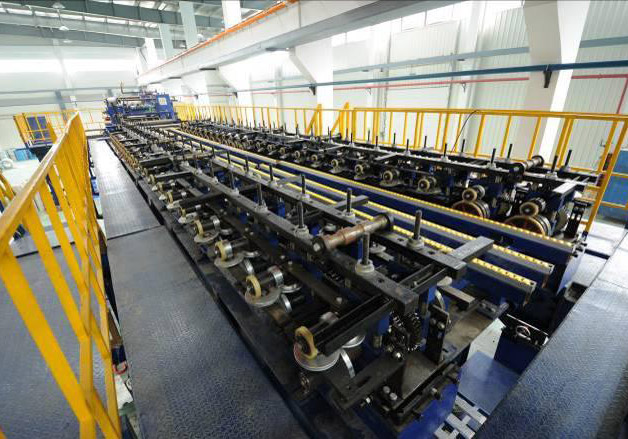
What this machine does
A PU sandwich panel line runs two coil lines in parallel, forms the upper and lower skin, foams the polyurethane core between them and cuts panels to length without stopping. The result is an insulated panel with a consistent core density along its whole length, which is what a cold store wall or a clean room partition actually depends on.
Machine configuration
| Function | Continuous production of polyurethane insulated sandwich panels |
|---|---|
| Raw material | Prepainted steel coil, galvanized coil, stainless coil for food grade panels |
| Panel construction | Upper and lower skin with foamed PU core and formed edge joint |
| Foaming | Continuous PU foaming station with density and thickness controlled on the line |
| Cutting | Flying cut for panel length; edge trimming in line |
| Control system | Line PLC with touch screen, coordinated across forming, foaming and cutting |
| Power supply | Three-phase, voltage and frequency matched to destination country |
| Optional stations | Embossing, film lamination, groove and tongue edge profiling |
| Roll design | Designed in-house with German COPRA roll forming software |
Typical applications
- Cold storage construction — wall and ceiling panels for freezer and chiller rooms
- Prefabricated buildings — insulated wall and roof panels for modular units
- Clean rooms and food plants — panels with hygienic, easily cleaned surfaces
- Panel manufacturers — standard thickness ranges produced for stock
How to specify your line
- Fix panel thickness range first. The foaming station and the side guides are built around a thickness band, so widening it later is a rebuild rather than an adjustment.
- Decide the core chemistry. PU, PIR and mineral wool cores need different foaming or lamination equipment, so the chemistry comes before the layout.
- Agree the edge joint. Groove and tongue, hidden fixing or cam-lock joints change the profiling stations.
- Plan the chemical supply. Continuous foaming depends on stable polyol and isocyanate supply and on temperature control in the plant, which is as important as the line itself.
Delivery and service
- Minimum order — 1 set, configured to the panel range.
- Payment — L/C or T/T.
- Incoterms — CFR, FOB, CIF, EXW.
- Shipping — ocean freight from Shanghai port.
- Overseas support — service outlets and showrooms in Canada, Egypt, Turkey, the United Kingdom, the United States, Italy, France, Brazil, Peru and Saudi Arabia; out-of-warranty support online.
Frequently asked questions
What does a polyurethane sandwich panel line cost?
Price depends on panel thickness range, line speed, foaming system, edge joint design and optional embossing or lamination. Send the panel specification for a configured quotation.
Can the same line run PIR or mineral wool cores?
Each core chemistry needs different equipment; the line is configured for one primary chemistry and the alternatives are addressed at specification stage.
Is panel thickness adjustable during production?
Thickness is set within the band the line was built for, and changes are made at the foaming station rather than by swapping rolls.
What is the minimum order quantity?
One set, configured to your panel range.
What is the lead time?
Confirmed once panel thickness range, chemistry and edge joint are fixed, because they determine the line length and station count.
What terms and support do you offer?
L/C or T/T, CFR, FOB, CIF or EXW, ocean freight from Shanghai, with out-of-warranty support handled online and overseas service outlets in ten countries.
Related Products

Contact US
Product Information
Quantity
Unit
Piece
Support order samples, customization, wholesale direct, and complete payment. If the product you look for does not have corresponding customized content, pls fill out the form below to contact us, and we will reply ASAP.